AI in 2026: Are You Still Learning It Like It's 2022?
Back in 2022, learning AI was pretty simple. You learned:
ChatGPT
Claude
Prompt engineering
Few-shot prompting
Fine-tuning
Embeddings
Maybe a bit of basic RAG
Basically, you learned how to ask an AI better questions. That was useful.
But AI has moved on. Fast.
The big question in 2022 was:
"How do I get a better answer from an LLM?"
In 2026, the question has become:
"How do I build a reliable system around an LLM — one that understands context, uses tools, retrieves info, takes actions, remembers things, handles failures, stays safe, and doesn't cost a fortune?"
That's a completely different engineering problem. And honestly, a lot of AI roadmaps out there are still stuck back in 2022.
How the AI stack has evolved
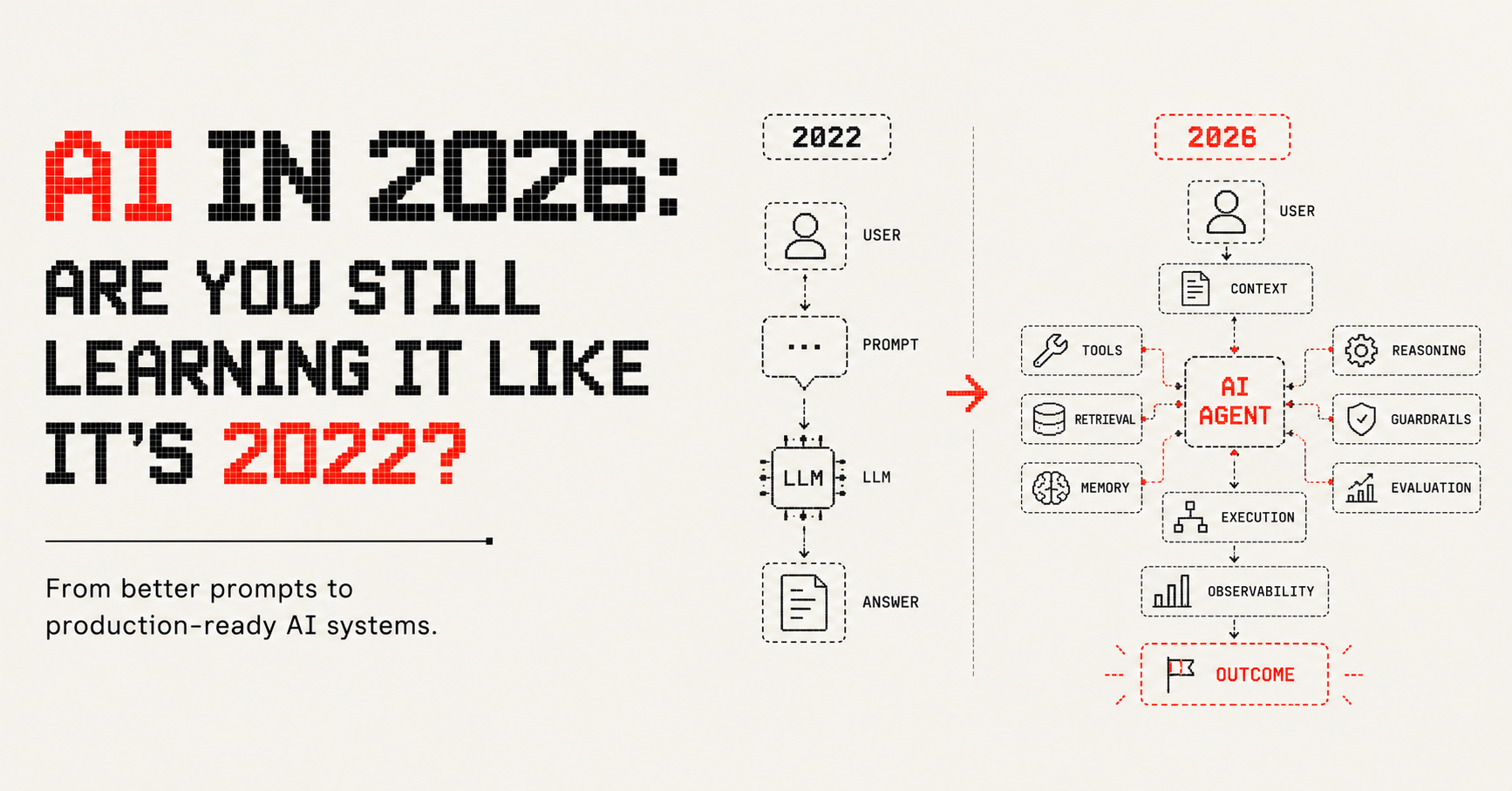
2022: User → Prompt → LLM → Answer
2024: User → Prompt → LLM → RAG → Tools → Answer
2026: User → Context → Agent → Reasoning → Retrieval → Tools → Memory → Execution → Guardrails → Evaluation → Observability → Outcome
The LLM still matters, obviously. But it's no longer the whole app — it's just one piece of a much bigger system.
Anthropic even talks about this shift as moving from prompt engineering to context engineering: it's not just about how you word a prompt anymore, it's about managing everything the model can see — instructions, tools, data, history, all of it.
That single shift says a lot about where things are heading.
So what's actually changed?
1. Prompt Engineering → Context Engineering
Prompt engineering used to ask: "What should I tell the model?"
Context engineering asks: "What does the model need to know right now?"
That could mean system instructions, user info, chat history, retrieved docs, tool descriptions, tool results, memory, past actions, current task state, external data — the list goes on.
The tricky part isn't stuffing in more info. It's picking the right info. Too little context and the agent's useless. Too much and things get noisy, slow, and expensive.
Anthropic treats context as a limited resource now — something you actively curate throughout a multi-step task, not something you dump into one giant system prompt.
2. Chatbots → Agents
A chatbot waits for you to ask something. An agent goes and does the work.
Chatbot: "Here's how you could troubleshoot your laptop."
Agent: "I checked your system info, found the likely issue, ran the diagnostic, and here's the next step."
The difference is action. Modern agents combine reasoning, tools, retrieval, memory, planning, state, approvals, and execution — all in one loop.
The question isn't "which model should I use?" anymore. It's "what should I actually let the model do?"
3. RAG → Agentic RAG
Basic RAG is: Question → Search → Documents → LLM → Answer. Simple.
But real-world systems often need more thinking baked in — like, should I search again? Is this the right source? Do I have enough evidence to answer confidently?
That's where things like hybrid search, reranking, query rewriting, multi-query retrieval, graph RAG, and citation tracking come in. RAG isn't just "a vector database bolted onto an LLM" anymore — it's part of a decision-making loop.
4. Function Calling → Tool Use
Function calling used to feel cutting-edge. Now agents can reach for APIs, databases, browsers, files, Python, shell commands, cloud services, and internal company tools.
The model decides when it needs a capability. Your app decides what's actually allowed. That distinction is everything.
So the skill isn't "I know how to call an API" anymore — it's "I know how to design safe, reliable tool access for an AI agent."
5. APIs → MCP (Model Context Protocol)
MCP is basically a standard way to connect AI systems to external tools and data, instead of hand-building a custom integration every single time.
It's evolving fast too — recent updates have made the protocol more stateless, added support for multi-round requests, stronger authorization, and better handling of long-running tasks. This is quickly becoming core infrastructure for agents, not just another buzzword.
6. One Agent → Multi-Agent Systems
Not every problem needs five agents working together. But some naturally split into specialties — think a manager agent coordinating a research agent, a data agent, a coding agent, and a validation agent.
The real question becomes: which agent should handle which job? Patterns like "handoffs" (one agent fully takes over) and "agents-as-tools" (a specialist works under a manager) are becoming common. It starts to feel a lot more like distributed systems than a simple chatbot.
7. Agent-to-Agent Communication (A2A)
Take it one step further: what happens when two separate AI agents need to talk to each other? That's what A2A (Agent-to-Agent) is about — making agents interoperable.
Adoption has been picking up fast, with well over a hundred organizations now backing the standard as a production-ready way for agents to work together. So increasingly, an AI system doesn't have to do everything itself — it can just team up with another one.
8. Chat History → Memory + State
A chatbot remembers your last few messages. An agent needs way more: working memory, long-term memory, user preferences, task state, past actions, checkpoints, the ability to pause and resume.
Imagine an agent working for 30 minutes, getting interrupted, and picking up right where it left off later. That's not "chat history" — that's real state management, and it's becoming a serious engineering problem on its own.
9. "Is the Answer Right?" → "Did the Agent Do the Job Right?"
This might be the biggest shift of all.
An agent can give you the correct final answer while still being completely broken underneath — it might've used the wrong tool, pulled from a shady source, taken 20 pointless steps, leaked sensitive data, blown the budget, skipped a required approval, or just quietly guessed.
The answer looks fine. The system is not.
That's why modern agent evaluation now looks at traces, graders, tool-call accuracy, handoff behavior, and full task trajectories — not just "was the final answer correct." The mindset shift is: evaluate the process, not just the output.
10. Logs → Observability
Regular software gives you logs. Agentic systems give you a full execution path — model calls, retrieval steps, tool calls, results, handoffs, guardrail checks, approvals, and finally a response.
Without proper tracing, debugging this becomes a nightmare. So tracing, spans, latency, token usage, cost tracking, and failure logs are turning into must-have skills, not nice-to-haves.
11. Safety Filters → Guardrails
A chatbot mostly just generates text. An agent can take actions — and that raises the stakes.
You now need input/output guardrails, tool guardrails, approval workflows, permission boundaries, PII protection, prompt-injection defenses, secrets isolation, audit logs, and human-in-the-loop checks for anything risky.
This is the real difference between "AI that talks" and "AI that acts."
12. Bigger Model → Better System
Sometimes the answer really is "use a bigger model." But often the real bottleneck is architecture — better context, better retrieval, better tools, better routing, better verification. A smaller model with a well-designed system can easily beat a bigger model with a sloppy one.
13. Model Selection → Model Routing
Production apps don't always need the most expensive model for every task. You might route simple classification to a small model, everyday reasoning to a medium one, hard problems to a big reasoning model, and specialized jobs (vision, embeddings, safety checks) to dedicated models.
That's model routing — picking the right model for the right job, based on cost, latency, and capability.
14. Token Optimization → AI Cost Engineering
An agent can call a model dozens of times, pull in huge amounts of context, use multiple tools, and run for a while. So the metric that matters isn't "cost per API call" — it's cost per successful task.
That pushes engineers toward prompt caching, context trimming, smarter routing, token budgeting, fewer unnecessary tool calls, and better retrieval. In agent systems, cost is an architecture decision, not just a line on a bill.
15. Code Generation → Sandboxed Execution
Instead of just generating code for a human to copy-paste, agents can now write code, run it in a sandbox, check the output, fix bugs, and try again — all on their own.
That means AI engineering now has to deal with sandboxing, filesystem and network restrictions, package management, resource limits, and recovery. It's touching infrastructure and security way more than before.
The 2026 AI stack, in one picture
Models – LLMs, reasoning models, multimodal models, embeddings, rerankers
Context – prompting, retrieval, memory, state, history
Intelligence – reasoning, planning, task breakdown, verification
Actions – function calling, tools, APIs, MCP, browser & code execution
Orchestration – agent loops, workflows, handoffs, multi-agent, A2A
Runtime – sessions, persistence, checkpointing, sandboxes, retries
Safety – guardrails, approvals, permissions, injection defense
Quality – evals, trace grading, regression tests, red teaming
Production – observability, tracing, cost optimization, routing
Wait — is prompt engineering dead?
Nope. It's still useful. It's just become one piece of a much bigger discipline.
Nobody says "Git is dead because CI/CD exists." Nobody says "SQL is dead because data engineering exists." Same logic here:
Prompt engineering isn't dead — it's just a smaller slice of a much bigger pie now.
The real shift, in three lines
2022: Learn to talk to AI.
2024: Learn to connect AI to data and tools.
2026: Learn to build systems that reason, retrieve, remember, act, collaborate, evaluate, and stay safe — all at once.
You don't need to chase every buzzword or slap together a 12-agent pipeline because someone posted it on LinkedIn. But it helps to know where things are headed.
There's a real difference between building a chatbot and engineering an AI system — and that gap keeps growing.
What should you actually learn now?
Don't build your roadmap around product names — build it around skills:
LLM fundamentals – tokens, context windows, reasoning, embeddings, tool calling
Context engineering – controlling what the model sees, and when
RAG – retrieval, hybrid search, reranking, grounding
Agents – loops, planning, tools, state, orchestration
MCP + A2A – how systems connect to tools and to each other
Memory – sessions, persistence, long-running workflows
Evaluation – measuring quality at the whole-workflow level
Guardrails & security – permissions, approvals, prompt injection
Observability – tracing and debugging an agent
Cost engineering – keeping things useful without breaking the budget
One last thought
It's easy to get overwhelmed chasing every new AI buzzword. A better approach is to just ask: what problem does this actually solve?
RAG → knowledge access
MCP → tool/context integration
Memory → persistence
Agents → multi-step action
Evaluation → reliability
Guardrails → control
Observability → debugging
Model routing → efficiency
A2A → agents working together
Context engineering → giving the model the right info at the right time
Once you see the problem behind the buzzword, the buzzword stops being scary.
So if your AI roadmap still looks like ChatGPT → Prompt Engineering → RAG — don't panic. Just keep adding layers. The industry didn't stop at prompts. AI engineering just got a lot bigger. And honestly? That's the fun part.
References
Anthropic — Effective Context Engineering for AI Agents
OpenAI — Agents, Tools, Guardrails and Observability
OpenAI — Evaluate Agent Workflows
Model Context Protocol — 2026-07-28 Specification
Linux Foundation — A2A Protocol adoption and production standard
Comments
Join the discussionNo comments yet. Be the first to comment.


